Analysis and optimization of post-tensioned precast concrete bridge segments
Precasting details simplified
Faster erection and improved durability
Finley Engineering Group, Inc. (FEG) of Florida is providing final design and construction engineering services for six segmental bridges on Israel Road 431 project – the first in Israeli bridge construction history to use external tendons. FEG used LUSAS Bridge to analyse and optimize the pier and deviator segment diaphragms for the imposed loadings whilst keeping the segment weight within the 65 tonne lifting capacity of the contractor equipment. As a result of FEG design the owner and contractor were provided with major benefits from simplified precasting details, thinner sections, rapid erection procedures and improved long-term durability..
Overview
Israel has constructed more than 25 segmental bridge structures in the last 20 years. But despite the country considerable experience with segmental bridges, the six FEG-designed bridges for one of the interchanges on the 21km long, Design-Build-Operate-Transfer venture will be the first in Israeli bridge construction history to use external tendons. These 12.5m wide bridges have span lengths ranging from 30m to 66m and consist of 501 precast segments with a total deck area of more than 18,000 square metres.
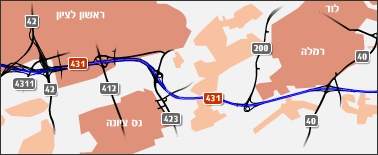
Road 431 Project, Israel
Road 431 is one of the lateral access roads to the Cross Israel Highway (Highway 6) and actually constitutes the southern traffic artery of the ring orad surrounding the Greater Tel Aviv Metropolitan Area (Gush Dan), consisting of Ayalon Highway in the West, Highway 6 in the East and Road 531 in the North.
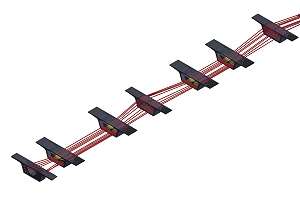
Schematic of end, deviator and pier segments showing the external tendon arrangement
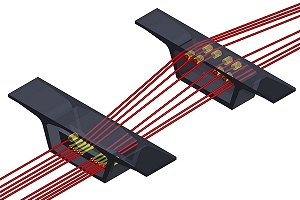
Schematic of a deviator and a pier segment showing tendon arrangement
The design process included a technical review by Israeli General Consultant engineers to confirm that the external tendon system adequately met the project requirements. To assist the Israeli engineers in evaluating external tendon post-tensioning systems, FEG produced a technical white paper that included details of previous projects, excerpts from technical articles, and a list of benefits that the external tendons bring to the project. It also included FEG analysis of tendon loss scenarios to meet strict bridge security requirements and design methodology for service and ultimate limit state design with external tendons.
External tendon benefits
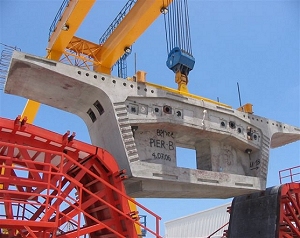
The use of external tendons also provided technical advantages in the bridge design, such as increased ductility for flexural moment resistance and a significant reduction in principle tensile stresses in the box girder webs. These benefits allowed for longer, constant-depth span lengths for the bridges while still meeting the interchange design requirements. “The large anchorage zones required for external tendons presented a challenge in keeping the pier segment weight within the 65 tonne lifting capacity of the contractor equipment “, said Craig Finley, President of Finley Engineering Group, “but by using LUSAS we easily modified complex shapes and efficiently optimized the internal pier segment dimensions”.
Along with the introduction of external tendons, FEG incorporated several other innovations on this project, including the use of diabolos in the pier segments and deviators to simplify the external tendon details. These post-tensioning details allow for replacement of the external tendons should this be required in the future. FEG also specified the use of pre-packaged grouts, multiple levels of protection and enhanced duct systems to improve post-tensioning system performance.
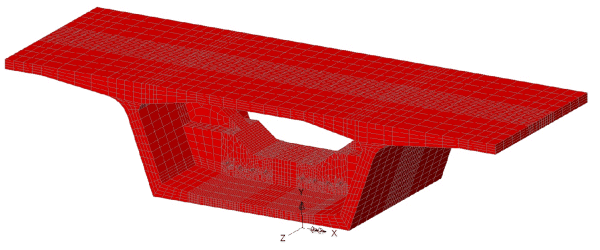
Deviator segment model
Typical stresses in deviator segment model
Jerry Pfuntner, Principal Engineer at FEG said: “The segment models created with LUSAS Bridge helped the Israeli design reviewers to feel comfortable with the external tendon details. The models showed the stress levels in the box girder webs, bottom and top slabs as a result of the external deviation forces. This helped FEG to obtain approval and assure all parties that these details would work well under service load conditions”.
In summary
The use of external tendons on a segmental bridge project is not a revolutionary concept. But, by assessing the contractor needs and introducing proven segmental bridge technologies to the Israeli construction practice, this approach by FEG provided recognized benefits to the owner and contractor with simplified precasting details, rapid erection procedures and improved long-term durability. Design of the bridges on this interchange of the Road 431 project offers another case study in the benefits of meeting challenges by seeking solutions that go beyond standard practice and “conventional wisdom”.
“LUSAS Bridge has been a great tool for us on this project. It allowed us to produce a design that has major benefits for the client and contractor. We would recommend its use to others wanting to enhance their in-house design and analysis capabilities”.
Craig Finley, President, Finley Engineering Group Inc.